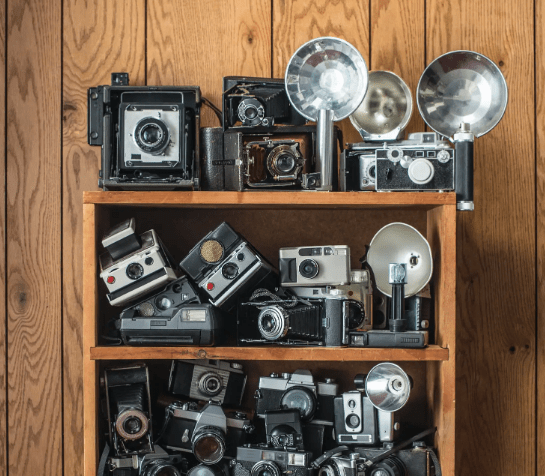
This article might sound like a “sick” 😆 story, it is about the cameras and gears I have had over the past 17 years. Before writing it, I asked myself: “Will somebody want go through that, honestly?!”. This could sound like an awkward therapy session! It could be handy though for a young budding photographer in search for inspiration and could be useful in order not to waste a lots of money, as I did…
I entered the world of photography in 2009 with a modest, tiny Lumix Panasonic DMC-FS3.
I started to get serious thanks to a Canon EOS 1000D: this was a present that my mum gave to me, thanks to her Esselunga (= Nectar) points. In 2012 I skipped to Canon 5D Mark II and then, in 2013, to a Canon 5D Mark III. I loved those 2 bodies.
However, I wasn’t fully convinced with the warm colors of Canon sensors (and their yellowish-orangy-reddish nuances), so I decided to change and to buy Nikon in early 2014. I used this brand for 10 years. My “Nikon family” was composed, over the years, of more digital bodies: D700, D650, D800, D200, D300 and D750 + 2 analog cameras, F801s and F5. Within Nikon, my biggest love was the D700 that I think is one of the best digital bodies ever made and is a cult for portraits. As for lenses I had many of them, the ones I used the most were a 50 mm F1.4 and a 85 mm F 1.8.
Guess what?! I moved back to Canon in late 2023!
I decided to go for a mirrorless body, so I picked up the Canon Eos R6 Mark II and I discovered that…I pretty much dislike mirrorless technology!! It seems like taking photos with a computer.
I am therefore gladly back to DSLr cameras. Now I have one Canon Eos 5D Classic, one 1Ds Mark III (the very last purchase, “a tank” with a weight of 1.4 kilos, without lenses!) two 5D Mark II, one 5D Mark III. As film cameras I have one AT-1 and one Eos 850.
Based on my experience, what I have learnt is:
1. Figure out what you like to photography. This will be of help when you chose the camera body with the proper gear.
2. I ‘d rather focus on a single brand, remaining loyal to it and growing with it over time, rather than wasting lots of energy and money looking for the “perfect” kit or formula. The desire to improve is human and smart, but don’t let it become a tricky, triggering mechanism inside your mind. It goes without saying that it is the photographer who makes the photo and not the camera.
3. Take responsibility for your taste and for your choices. Focus on them.
4. Trust your instincts when making choices, but also analyze the results of your work: Do you like the texture, the colors of your pictures?
5. If you’re lazy like me and you are not going to read the manuals 😜, there are plenty of videos on YouTube that you can watch and that will easily allow you to learn. I would recommend the ones by Cesare Ferrari, in case you are a Canon user.
 Elena Arvasi Portrait Photographer